Associated Agent ∙ OrangeTee
Png Hwee Leng


Associated Agent ∙ OrangeTee
Png Hwee Leng

About Png Hwee Leng
Professional Real Estate Agent committed to providing exceptional service and expertise in the property market.
Contact Png Hwee Leng
Png Hwee Leng Social Links
No social links available.
My Listings
No listings available at the moment.
Our newly launched projects
Discover the real estate properties in and around Singapore, Singapore. Buy apartment units, landed houses, bungalows, commercial office space, shop lots, and sub-sales with 100% confidence at IQI Global.

Lumiere
2 Mistri Road Singapore (079624)
Starting from RM 3,021,004
Listed on March 6, 2021
Reignwood Hamilton Scotts
37 Scotts Rd, Singapore 228229
Starting from RM 35,357,611
Listed on December 31, 2020
Verticus
3 Jalan Kemaman Singapore 329343
Starting from RM 3,019,239
Listed on December 16, 2020
Verdale
2 - 16 De Souza Avenue Singapore 599458
Starting from RM 2,985,176
Listed on December 16, 2020
Treasure at Tampines
118 - 135 Tampines Street 11 Singapore
Starting from RM 3,564,250
Listed on December 16, 2020
Stirling Residences
21-25 Stirling Rd, Singapore 148961
Starting from RM 2,994,466
Listed on December 16, 2020
Mortgage Calculator
Calculate your estimated month repayment and plan your monthly expenses well.
The mortgage calculator is intended for reference only. Actual amount may vary.
Monthly Payment
Send me the mortgage calculator result

Home Loan Eligibility Calculator
Calculate your potential loan amount and assess your home buying affordability.

Rental Yield
Calculate the potential rental yield and evaluate a property's investment performance.

Down Payment Saving Plan
Create a structured savings plan and determine how much to save monthly for your down payment plan.

Malaysian Property Transaction Fees Calculator
Estimate the total transaction fees and budget accurately for your Malaysian property purchase.
IQI blog & news
Articles specifically curated for your daily digest of local and global real estate news.

For years, the “10% down-payment rule” has been one of the biggest psychological and financial barriers to homeownership in Malaysia. The assumption was simple: no large cash reserve, no entry. Budget 2026 changes that narrative, placing greater emphasis on financing accessibility rather than affordability alone. With enhanced policy tools now in place, aspiring homeowners may no longer need to delay their plans until they have saved a significant lump sum—provided they understand how to use the right mechanisms strategically. The key financial levers in 2026 include the expanded Housing Credit Guarantee Scheme (SJKP) with up to 120% guarantee coverage, full stamp duty exemptions for eligible first-time buyers, and strategic use of EPF (KWSP) as a liquidity bridge. Together, these tools can significantly reduce upfront cash requirements and improve purchase feasibility, subject to eligibility and bank assessment. The real question in 2026 is no longer how fast one can save 10%, but which combination of tools best fits individual income profiles and cashflow. Buyers who assess their SJKP eligibility early, confirm stamp duty relief, and plan EPF usage responsibly will be best positioned to turn homeownership from intention into action. Download the full report for deeper market insightsDownload
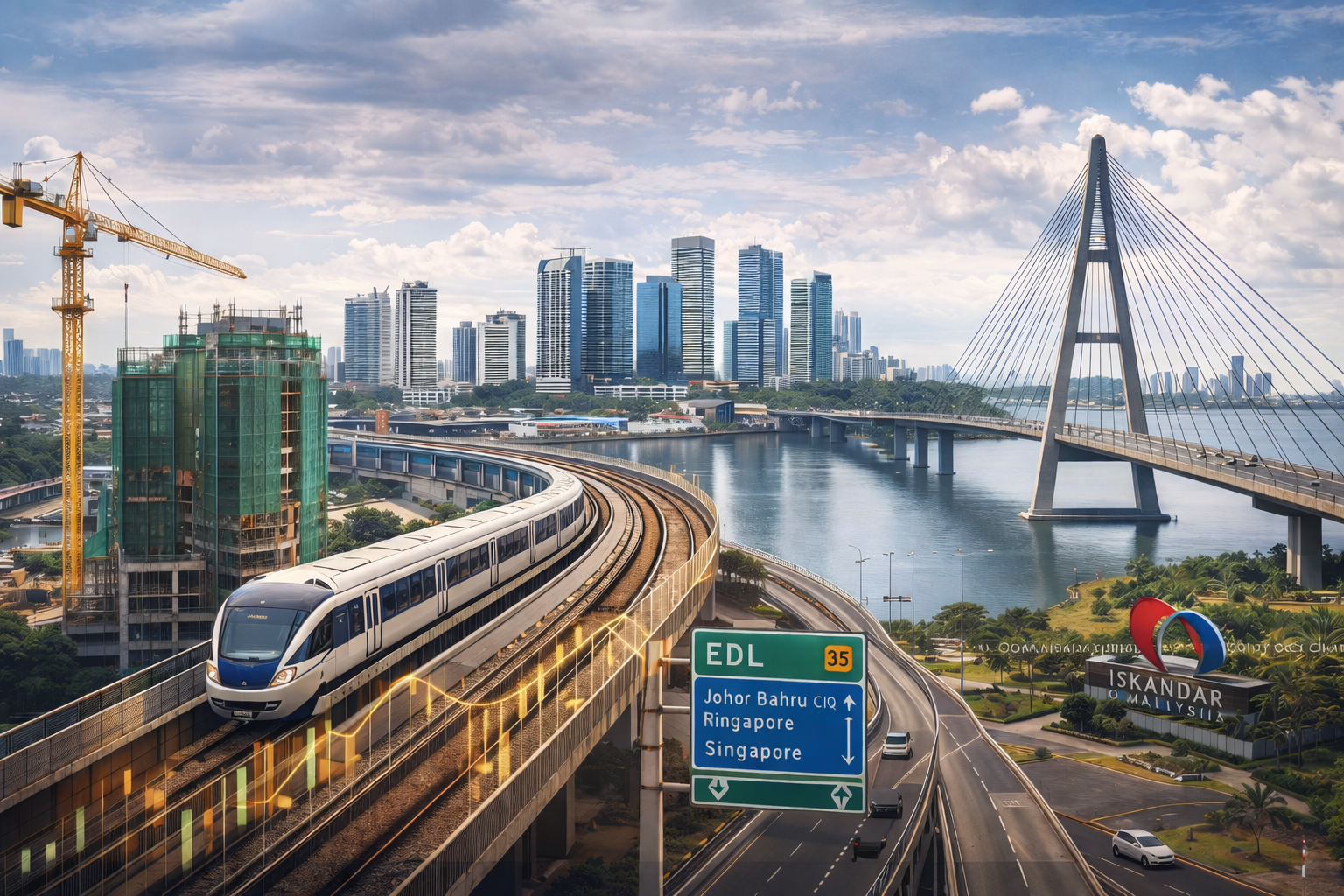
Johor’s property market continues to expand, but the focus is shifting from pure growth to infrastructure readiness. According to Kashif Ansari, Co-Founder and Group CEO of Juwai IQI, the defining issue shaping real estate decisions is no longer just location or pricing, but access to electricity and water. As highlighted in coverage by Astro Awani and Bernama, developments without secured utility access are facing rising uncertainty, while infrastructure-ready land is gaining premium value. This shift is being accelerated by Malaysia’s rapid emergence as a regional data centre hub. Data centres are intensive users of power and water, and according to global insights from the International Energy Agency, demand is growing faster than supporting infrastructure can be delivered. Mr Ansari describes this imbalance as a “power pinch,” already influencing developer site selection, investor risk assessment, and project design. While Johor sits at the centre of this trend, the implications extend nationwide, signalling that infrastructure availability will increasingly guide pricing, timing, and momentum across Malaysia’s property market. Download the full report for deeper market insightsDownload

As February 2026 unfolds, the global economy is showing encouraging signs of stability, supported by steady GDP growth forecasts and accommodative monetary policy across major markets. Emerging economies particularly in Asia and parts of Latin America are expected to drive much of this momentum. While geopolitical tensions have introduced some uncertainty, markets have remained resilient, with investors gravitating toward structural growth themes such as technology, renewable energy, and advanced manufacturing. At the same time, gold and precious metals are quietly strengthening, reinforcing their role as effective portfolio hedges. In this environment, success favours investors who stay anchored to fundamentals anddiversification. Balancing growth assets with defensive allocations like fixed incomeand alternatives helps manage volatility while preserving upside. Real estate continues tostand out, especially in multifamily housing, logistics, and niche commercialsegments, where long-term demand and tight supply support income potential. Withfinancing conditions improving in select markets, 2026 is shaping up to be a year wherediscipline, agility, and thoughtful diversification turn uncertainty into opportunity. Download the full report for deeper market insightsDownload

Markets Re-Enter an Age of Alchemy The year has barely begun, yet the alchemy of global markets has already shifted. Rising geopolitical risk, the resurgence of AI-led capital expenditure, buoyant equity markets, and precious metals at stratospheric levels are rapidly reshaping the investment landscape. Investors are no longer chasing growth at any cost. Priority has shifted to growthwith peace of mind, capital deployed with durability, visibility, and long termsustainability, rather than fleeting momentum. Artificial intelligence has reentered the cycle with conviction. This phase is infrastructure driven, capitalintensive, and productivity enhancing, positioning AI as a powerful GDP catalyst over the next three to five years, particularly across ASEAN, the GCC, and parts of Africa, where policy alignment and digital adoption are accelerating. At the same time, history is reasserting itself. The 1970s are back in style. Inflationsensitivity, geopolitical fragmentation, and currency debasement have restored realassets to center stage. 2026 is shaping up to be the year of tangibility. Gold and silver are heading toward vertiginous levels, while real estate has evolved into a new global currency, offering inflation protection, yield resilience, and geopolitical optionality. Markets evolve; technologies advance but history repeats. Those who grasp the convergence of innovation and real assets will be best positioned for the next phase of global economic realignment. US EQUITY MARKET OUTLOOK: OVERVALUED AT PRESENT. U.S. equities are at historic valuationextremes expectations elevated, riskpremiums compressed. The Buffett Indicator above 210% signals assets priced for perfection, driven by AI exuberance, mega-cap concentration, and excess liquidity. Buffett’s USD 330 billion cash pile says it all: at peaks, liquidity is strategy. History is clear—after valuation extremes, Real assets outperform through preservation, not speculation. FASTEST GROWING ECONOMIES IN 2026 - OECD OUTLOOK The latest OECD Economic Outlook (December 2025) revealed that the global economy has proved resilient last year, even though fragilities remain, with a range of risks including "elevated policy uncertainty and rising barriers to trade". According to the organization's forecasts, global GDP growth is projected to slow down from 3.2 percent in 2025 to 2.9 percent in 2026. As our infographic shows, among G20 economies (together accounting for around 80 percent of global GDP), some countries are expected to continue growing at a pace well above the average.India tops the list, with a real GDP growth expected to exceed 6 percent again this year (6.7 in 2025; 6.2 in 2026), driven by robust domestic demand, digital transformation andmanufacturing growth. Indonesia follows at 5.0 percent (rate in 2025 and 2026), leveraging its young workforce and commodity exports. China, though facing structural slowdowns, remains a key player with 4.4 percent economic growth projected this year (after 5.0 percent in 2025). Saudi Arabia follows closely at 4.0 percent, buoyed by oil revenues and ambitious economic diversification efforts under the "Vision 2030" national plan TOP COUNTRIES HOLDING RARE EARTH IN THE GLOBAL World's Largest Rare Earth Reserves. Rare earths are crucial for EVs, wind turbines, smartphones, batteries, and defense tech. They are heavily concentrated: China holds nearly half the world’s known reserves and even more dominance in actualmining and refining (~85–90% of processed rare earths). This concentration is a majorstrategic vulnerability for the West, driving efforts to develop alternatives. Greenland’sreserves are increasingly in focus especially with US interest in Arctic resources. Download the full report for deeper market insightsDownload
Ready to get started?
Get in touch now.